

Everything Project Managers Need to Know About the New PMP Exam 2026
Published by Scrumconsult.com | Updated: 2026
If you have been watching the project management certification space, you already know that 2026 is a landmark year. PMI® has officially released the new PMP® Exam Content Outline (ECO) 2026 — and it brings the most significant structural overhaul the PMP certification exam has seen since 2021. Whether you are a seasoned project manager renewing your credential, a beginner mapping out your PMP exam guide, or a working professional wondering how these PMP exam changes affect your study plan, this guide covers it all in one place.
From updated domain weights and new question formats to the rise of AI in project management and the integration of sustainability into the PMP syllabus, we break down exactly what the pmp exam content outline 2026 means for you — and how to come out on top. Let’s get started.
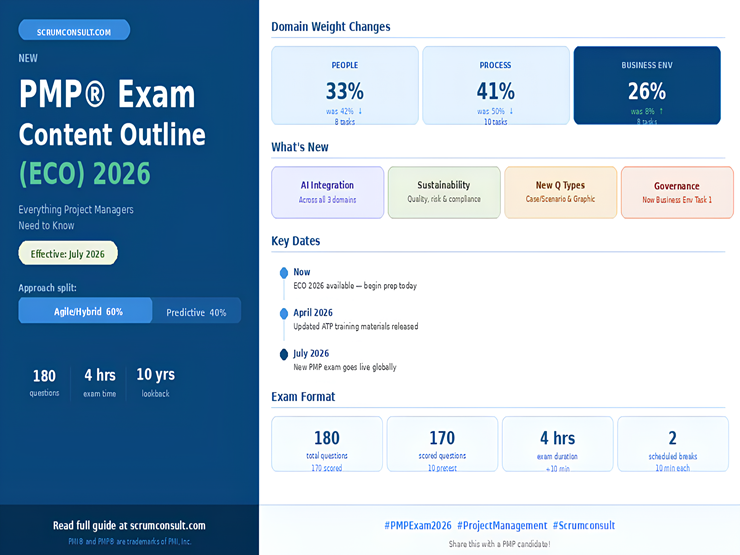
| Quick Summary: The new PMP ECO 2026 takes effect in July 2026. It restructures domain weights, introduces new question types, expands the Business Environment domain from 8% to 26%, and officially integrates AI and sustainability into the PMP exam. The PMP exam reference list and updated training materials from PMI-approved partners become available in April 2026. |
What You’ll Learn in This Guide
- What is the New PMP Exam Content Outline 2026?
- Why PMI Updated the PMP ECO 2026
- PMP Exam Dates 2026 and Key Timeline
- Domain-by-Domain Breakdown: People, Process, Business Environment
- PMP Exam Format 2026: What’s Changing
- The Agile and Hybrid Shift: What It Means for Your Exam
- AI and Sustainability in the New PMP Exam
- PMP Exam and PMBOK 8th Edition: What’s the Connection?
- Eligibility Changes: Who Can Apply?
- How to Prepare for the New PMP Exam 2026
- Old vs. New ECO: Key Differences at a Glance
- Frequently Asked Questions
What is the New PMP Exam Content Outline 2026?
The PMP Exam Content Outline (ECO) is the official blueprint published by the Project Management Institute (PMI®) that defines every domain, task, and enabler the PMP certification exam tests. Think of the ECO as the authoritative PMP exam reference list — not a textbook, but the definitive map of the skills and judgment PMI expects working project managers to demonstrate.
The PMP ECO 2026 replaces the January 2021 version and was developed through a rigorous Job Task Analysis (JTA) conducted with the help of Alpine Testing Solutions. PMI surveyed thousands of active project professionals, PMO leaders, and hiring managers across industries to determine what project managers actually do — and what skills matter most in today’s environment. The result is a new PMP exam content outline that is more strategic, more agile-forward, and more aligned with modern business realities than any previous version.
The pmp exam content outline pdf is available directly on the PMI website and serves as the single most important document for any candidate preparing for the pmp exam 2026. If you haven’t downloaded it yet, do so before you buy a single prep book or sign up for a course.
Why PMI Updated the PMP ECO 2026
PMI updates the PMP exam roughly every four years to reflect how the practice of project management is evolving. The 2026 update was driven by five major trends that PMI’s JTA validated as genuinely reshaping what project managers need to know and do:
1. Artificial Intelligence (AI) as a Professional Competency
For the first time in the history of the PMP exam, AI in project management is explicitly acknowledged as a trend shaping the exam. The PMP exam and AI connection is not a standalone module — AI-related decision-making contexts are woven throughout all three domains. Expect scenario questions involving AI-assisted planning, predictive analytics, and intelligent risk analysis.
2. Sustainability as a Core Requirement
PMP exam sustainability is no longer a fringe topic. The new ECO embeds sustainability directly into quality management tasks (managing cost of quality and sustainability), compliance requirements, and risk response planning. This mirrors the global shift toward ESG (Environmental, Social, Governance) accountability in project delivery.
3. Value Delivery Over Output Tracking
The old triple-constraint focus on scope, schedule, and budget has given way to something bigger. The pmp value delivery framework now defines success as delivering value worth the effort and expense — encompassing stakeholder outcomes, benefits realization, and strategic impact.
4. Governance as a Strategic Priority
In the old ECO, governance was buried inside Process tasks. In the 2026 ECO, governance becomes Task 1 of the Business Environment domain — signaling PMI’s view that governance is foundational, not administrative.
5. PMP Business Strategy Alignment
The pmp business strategy alignment theme runs throughout the 2026 ECO, pushing project managers to think like strategic partners, not just execution managers. PMI’s “Close the Gap” initiative reinforces this — elevating the perception of project management from task coordination to value creation.
PMP Exam Dates 2026 and Key Timeline
Planning your pmp exam dates 2026 correctly is critical given the transition happening this year. Here is the official schedule you need to know:
| Date / Period | What Happens |
| Now (2026) | Updated PMP® ECO 2026 is publicly available on PMI’s website |
| Jan 5–30, 2026 | Exam Pilot Window — candidates sat the new exam at Pearson VUE centers (English only) for a 20% rebate |
| April 2026 | Updated PMI Authorized Training Partner (ATP) materials become available |
| July 2026 | Official launch of the new PMP® exam — all candidates tested under the 2026 ECO |
| July 2026 | PMBOK® Guide – 7th Edition officially retired |
| Until July 2026 | Current PMP exam (2021 ECO) remains available globally |
For pmp exam dates and locations 2026, the PMP exam is delivered globally at Pearson VUE test centers and via online proctored testing. Specific test center schedules and availability are managed through your PMI account on the PMI.org portal.
| Pro Tip: If you are mid-preparation and plan to sit before July 2026, your current study materials remain valid. After July 2026, all exams will be based exclusively on the 2026 ECO. |
pmp exam content outline 2026: Domain-by-Domain Breakdown
The pmp exam content outline 2026 retains the same three domains as the 2021 version — People, Process, and Business Environment — but the weight and content of each has shifted dramatically.
| Domain | 2021 Weight | 2026 Weight | Change |
| I. People | 42% | 33% | ↓ Down 9 points |
| II. Process | 50% | 41% | ↓ Down 9 points |
| III. Business Environment | 8% | 26% | ↑ Up 18 points (3x increase!) |
Domain I: People (33%) — The pmp people domain
The pmp people domain drops from 42% to 33% in weight, but don’t mistake that for reduced importance. The domain has been streamlined from 14 granular tasks down to 8 integrated, judgment-based competencies. Key themes include:
- Task 1: Develop a Common Vision — reframing leadership as vision-first, not task-first
- Task 2: Manage Conflicts — expanded to include ground rules and external stakeholders
- Task 3: Lead the Project Team — consolidated from multiple tasks; clearer role expectations
- Task 4: Engage Stakeholders — deepened stakeholder collaboration framework
- Task 5: Align Stakeholder Expectations — reframed mentoring into expectation alignment
- Task 6: Manage Stakeholder Expectations — new standalone task
- Task 7: Help Ensure Knowledge Transfer — moved from Process; shows knowledge as a people skill
- Task 8: Plan and Manage Communication — moved from Process to People domain
What has been removed: standalone training tasks, virtual team management as a separate task, and emotional intelligence as a standalone topic. These have been integrated into leadership and communication tasks throughout.
Domain II: Process (41%) — The pmp process domain
The pmp process domain drops from 50% to 41% weight and consolidates from 17 tasks to 10 tightly focused ones. The central themes are integrated planning, value delivery, and procurement. Highlights include:
- Task 1: Develop Integrated PM Plan — elevated to Task 1 and significantly expanded; now includes methodology selection
- Task 2: Develop and Manage Project Scope — retained and streamlined
- Task 3: Help Ensure Value-Based Delivery — reframes execution around value, not just output
- Task 4: Plan and Manage Project Resources — split from the old budget+resources task
- Task 5: Plan and Manage Procurement — retained with expanded enablers
- Task 6: Plan and Manage Project Finance — NEW dedicated financial management task (see below)
- Task 7: Plan and Optimize Quality — now explicitly includes sustainability and Cost of Quality (CoQ)
- Task 8: Plan and Manage Schedule — retained with minor expansion
- Task 9: Evaluate Project Status — NEW consolidated task replacing artifact management
- Task 10: Manage Project Closure — retained
| New for 2026: Task 6 (Plan and Manage Project Finance) is an entirely new, standalone task. It covers analyzing project financial needs, quantifying risk and contingency allocations, planning spend tracking, and managing financial reserves. This reflects the growing demand for financially literate project managers. |
Domain III: Business Environment (26%) — The pmp business environment domain
This is the biggest story of the new pmp exam 2026. The pmp business environment domain nearly triples — from 8% to 26%. But PMI has been clear: this is not an injection of new content. It is a strategic redistribution. Risk management, change management, and governance have been moved here from Process to elevate their strategic importance. The domain now has 8 tasks:
- Task 1: Define and Establish Project Governance — NEW as standalone Task 1; moved from Process
- Task 2: Plan and Manage Project Compliance — retained and expanded to include sustainability compliance
- Task 3: Manage and Control Changes — moved from Process; elevated to strategic level
- Task 4: Remove Impediments and Manage Issues — consolidated from People and Process
- Task 5: Plan and Manage Risk — moved from Process; now includes sustainability risk response
- Task 6: Continuous Improvement — NEW standalone task
- Task 7: Support Organizational Change — retained
- Task 8: Evaluate External Business Environment Changes — retained
The key insight for candidates: studying the Business Environment domain as a minor section will cost you the exam. At 26%, it now carries more weight than the old Business Environment domain ever did — and governance, risk, and continuous improvement are very testable.
PMP Exam Format 2026: What’s Changing
The pmp exam format 2026 carries some important structural updates. Here’s the full comparison:
| Feature | Current (2021 ECO) | New (2026 ECO) |
| Total Questions | 180 | 180 |
| Scored Questions | 175 | 170 |
| Pretest (Unscored) | 5 | 10 |
| Total Time | 230 minutes | 240 minutes (4 hours) |
| Breaks | 2 x 10 min | 2 x 10 min (repositioned) |
| New Question Types | Standard MCQ + drag-drop | Case/Scenario, Graphic-Based, Practicum (NEW) |
New PMP Question Types in 2026
The most impactful change in pmp question types for 2026 is the introduction of three new formats that require deeper, applied thinking:
Case/Scenario Questions
These are the pmp scenario-based questions taken to a new level. Candidates receive a detailed project situation — potentially including charts, burndown graphs, or stakeholder data — and must answer a series of 4–5 related questions based on that single scenario. The total reading burden is similar to the current format, but the depth of judgment required is higher.
Graphic-Based Questions
These require candidates to interpret visual data — burndown charts, earned value graphs, responsibility assignment matrices, or risk heat maps — and draw conclusions. This directly tests the data-literacy skills modern project managers use daily.
Practicum / Hands-On Testing
This format requires candidates to interact with simulated tools, data tables, or case study environments. It moves the PMP exam toward assessing applied competency rather than recall.
| Preparation Implication: Flashcard memorization alone will not get you through the 2026 PMP exam. You need practice reading complex scenarios quickly, interpreting visual data, and making integrated judgments — not just knowing definitions. |
The Agile and Hybrid Shift: pmp agile and hybrid questions
One of the most searched topics around the pmp exam 2026 is the balance between predictive and adaptive approaches. Here is the official split:
| Approach | 2021 ECO | 2026 ECO |
| Predictive (Waterfall) | ~50% | ~40% |
| Agile / Hybrid | ~50% | ~60% |
The agile pmp exam and hybrid pmp exam split in 2026 reflects real-world data: more organizations are using adaptive or blended delivery approaches than ever before. This means approximately 60% of your exam questions will describe scenarios rooted in agile or hybrid environments.
This is not about knowing Scrum ceremonies or SAFe frameworks in isolation. The pmp domains people process business environment all integrate agile thinking. You need to know how to choose between predictive, agile, and hybrid on the pmp exam — and more importantly, why a project manager in a given scenario would choose one over the other.
| Study Tip: Understand the ‘when and why’ of approach selection. PMI is not testing whether you prefer Scrum or Waterfall. It’s testing whether you can read a business context and recommend the right delivery strategy for the situation. |
AI and Sustainability: The Game-Changers in the New PMP Exam 2026
pmp exam and ai
The pmp exam and ai relationship is explicitly new in 2026. PMI’s JTA validated that artificial intelligence is genuinely reshaping how project managers plan, monitor, and decide. While AI does not appear as a standalone domain, ai in project management pmp topics appear as enablers and scenario contexts across all three domains.
What does this mean practically? Expect scenarios that ask you how a project manager should respond when an AI-generated risk forecast conflicts with team experience, or how to evaluate AI-assisted schedule recommendations. You do not need to be a data scientist — you need to understand AI as a decision-support tool and know how a responsible project manager uses and verifies it.
pmp exam sustainability
The pmp exam sustainability integration is more structural. Sustainability appears in at least three explicit places:
- Quality management: Managing Cost of Quality (CoQ) and sustainability together
- Compliance: Sustainability is listed as an explicit compliance requirement
- Risk management: Sustainability risks must be identified and managed with formal risk responses
This reflects PMI’s strategic partnership with Green Project Management (GPM) and the inclusion of sustainability in PMBOK 8. Project managers are increasingly expected to account for environmental and social impact — not just financial returns — as measures of project success.
pmp exam based on pmbok 8: What’s the Connection?
One of the most common points of confusion around the new pmp exam 2026 is how it relates to the PMBOK® Guide. Here is the definitive answer: the PMP exam is based on the ECO — not the PMBOK Guide. PMI has consistently reiterated this.
| Item | Role in PMP Exam | Status in 2026 |
| PMP ECO 2026 | THE exam blueprint — defines what is tested | Effective July 2026 |
| PMBOK® Guide 8th Edition | Reference for learning — does NOT define exam content | Released 2025/2026; free for PMI members |
| PMBOK® Guide 7th Edition | Previous learning reference | Retired July 2026 |
| PMP Exam Reference List | Supplementary reading list | Updated alongside the 2026 ECO |
The pmp exam based on pmbok 8 conversation is understandable given the timing of both releases, but do not let it distract you. Study the ECO. Use PMBOK 8 and the pmp exam reference list as learning companions, not as exam blueprints. If you are currently studying under PMBOK 7-aligned materials for the pre-July 2026 exam, you are fine.
Updated Eligibility Requirements for the PMP Exam 2026
PMI has quietly updated the eligibility requirements alongside the ECO. Here are the most important changes:
| Requirement | 2021 Version | 2026 Version |
| Experience lookback period | Last 8 consecutive years | Last 10 years |
| Secondary school + experience | 60 months | 60 months (unchanged) |
| Associate’s degree + experience | Not tiered | 48 months (new tier) |
| Bachelor’s degree + experience | 36 months | 36 months (unchanged) |
| GAC-accredited degree | 24 months + 12-month credit | 24 months (no extra credit) |
| Training requirement | 35 hours (must complete before application) | 35 hours (must complete before certification granted) |
| Education framework | Not required | EQF/ISCED mapping required (new international standard) |
| CAPM holder waiver | 23-hour credit (12 hrs needed) | 23-hour credit (unchanged) |
The extension of the experience lookback window from 8 to 10 years is good news for many candidates who have valuable experience from a few years back. The addition of EQF/ISCED framework mapping is significant for international candidates — it standardizes how educational credentials are evaluated globally.
How to Prepare for the New PMP Exam 2026
Whether you are a pmp for beginners starting your certification journey or an experienced professional updating your approach, here is the definitive pmp exam study plan built around the 2026 ECO.
Step 1: Get the Official pmp exam content outline pdf
Before anything else, download the pmp exam content outline pdf from PMI.org. This is your non-negotiable starting point. Read it cover to cover. Understand each domain, task, and enabler. This document is free.
Step 2: Audit Your Study Materials
If your prep materials predate 2026, audit them against the new ECO. Most existing content remains valid — around 85% of the 2021 ECO content carries over. But if your materials do not address governance as Task 1 of Business Environment, do not have dedicated AI/sustainability scenarios, or lack graphic-based practice questions, supplement them.
Step 3: Master Business Environment — Seriously
This is the biggest pmp exam preparation mistake candidates will make in 2026: treating Business Environment as a minor domain. At 26%, it is now the second-largest domain. Governance, risk management, change management, continuous improvement, and compliance must be studied with the same depth as People and Process.
Step 4: Practice Scenario-Based Questions Daily
The best way to study for the new pmp exam 2026 is to practice with scenario-based questions that mirror real project situations. Avoid question banks that rely on definition recall. Seek out multi-paragraph scenarios with 3–5 questions attached — these mirror the new Case/Scenario format you will face on exam day.
Step 5: Learn to Read Visual Data
Get comfortable with burndown charts, earned value curves, stakeholder matrices, and risk heat maps. The new Graphic-Based question type will require you to interpret these quickly under time pressure.
Step 6: Study AI and Sustainability in Context
You do not need to become an AI engineer or environmental scientist. You need to understand how a pmp exam for experienced project managers expects you to think about AI as a decision-support tool, and sustainability as a compliance and risk management responsibility. Read PMI’s own publications on these themes.
Step 7: Enroll in an ATP-Aligned Training Program
For pmp exam preparation for professionals, formal training aligned to the 2026 ECO is strongly recommended. Updated materials from PMI Authorized Training Partners (ATPs) become available in April 2026. If you are preparing now, ensure your training provider has a credible plan to update their curriculum before July.
| Key Tip for Beginners: If this is your first time approaching the pmp exam guide for beginners, start with the eligibility requirements, then download the ECO, then find an ATP-aligned training provider. The 35 contact hours of training can now be completed any time before your certification is granted — not just before your application submission, which gives you more flexibility. |
Old vs. New PMP ECO: Difference Between Old and New PMP Exam Content Outline
For those searching for the difference between old and new pmp exam content outline, here is the big-picture summary:
| Category | 2021 ECO | 2026 ECO |
| Total Tasks (all domains) | 35 tasks | 26 tasks (integrated) |
| People Domain | 42% | 14 tasks | 33% | 8 tasks |
| Process Domain | 50% | 17 tasks | 41% | 10 tasks |
| Business Environment | 8% | 4 tasks | 26% | 8 tasks |
| Predictive approach | ~50% | ~40% |
| Agile/Hybrid approach | ~50% | ~60% |
| AI in exam | Not mentioned | Formally integrated across all domains |
| Sustainability in exam | Not mentioned | Integrated in quality, compliance, and risk |
| Governance placement | Process domain sub-task | Business Environment Task 1 |
| New question types | None (MCQ + drag-drop) | Case/Scenario, Graphic-Based, Practicum |
| Exam time | 230 minutes | 240 minutes (4 hours) |
| Experience lookback | 8 consecutive years | 10 years |
Frequently Asked Questions About the PMP ECO 2026
What is the new PMP exam content outline 2026?
The new PMP exam content outline 2026 is the official PMI blueprint, effective July 2026, defining all domains, tasks, and enablers tested on the PMP certification exam. It replaces the January 2021 version and introduces updated domain weights, new question types, and integration of AI and sustainability.
How many domains are in the new PMP exam?
The 2026 PMP exam still has three domains: People (33%), Process (41%), and Business Environment (26%). The number of domains has not changed, but the task count has consolidated from 35 to 26, and the weight distribution has shifted significantly.
What percentage of agile and hybrid questions are on the 2026 PMP exam?
Approximately 60% of the 2026 PMP exam reflects agile or hybrid approaches, up from roughly 50% in 2021. The remaining 40% represents predictive (waterfall) approaches.
Can I still pass the PMP exam using my current 2021-aligned study materials?
If you sit the exam before July 2026, yes — your current materials remain fully valid. After July 2026, you will need materials aligned to the 2026 ECO. About 85% of content carries over, but Business Environment, AI, sustainability, and new question formats require updated preparation.
Where can I get the pmp exam content outline pdf?
Download the official pmp exam content outline pdf for free from the PMI website (pmi.org). It is publicly available and is the single most important document for your exam preparation.
Does the PMBOK Guide 8 determine the PMP exam content?
No. The PMP exam is based on the Examination Content Outline (ECO), not the PMBOK Guide. PMBOK 8 is a valuable learning reference and is free for PMI members, but it does not define what is tested. Always study from the ECO as your primary guide.
How hard is the new PMP exam 2026 compared to the old one?
Not necessarily harder — but different. The 2026 exam tests deeper judgment through scenario-based and graphic-based questions rather than knowledge recall. The Business Environment domain now carries far more weight, which catches unprepared candidates off guard. With the right pmp exam study plan built around the new ECO, experienced project managers are well-positioned to pass.
What is the best way to study for the new PMP exam 2026?
The best way to prepare for the pmp exam 2026 is: (1) download and study the official ECO; (2) enroll in an ATP-aligned training program updated for 2026; (3) practice scenario-based and graphic-based questions; (4) deeply study the Business Environment domain including governance, risk, and continuous improvement; and (5) understand how AI and sustainability appear across all three domains.
Final Thoughts: What the PMP ECO 2026 Means for Your Career
The new PMP exam content outline 2026 is not just a certification update — it is a signal about where the profession is heading. PMI is telling the world that project managers of tomorrow are strategic leaders who understand governance, embrace agile and hybrid delivery, manage sustainability as a real risk, and leverage AI as a responsible decision-support tool.
For candidates, this is exciting. The pmp certification exam has always been demanding, but the 2026 version tests skills that genuinely matter in today’s project environments — not just process frameworks from the last decade. If you invest in the right pmp exam preparation strategy, you will not only pass the exam but emerge better equipped for real project leadership.
Ready to get started? Download the pmp exam content outline pdf, align your study plan with the 2026 ECO, and begin preparing today. The pmi pmp 2026 exam is your opportunity to earn a credential that speaks directly to where project management is headed — for the next four years and beyond.This article is published by Scrumconsult.com. PMI® and PMP® are registered trademarks of the Project